
Find schools that have a building but no way to function. Deliver the equipment, IT and power that make them usable. Where schools are destroyed, put up rapid replacement classrooms. Do it fast, locally and transparently — then publish the proof.
We combine physical equipment, refurbished IT and solar power in one package — where most comparable organisations do only one.
We activate in the aftermath window and work through local partners, reaching the schools the large mechanisms serve last.
Every mission is documented and reported. Trust converts into repeat support — and that is the engine of the whole funding model.
Standardising this cycle is what makes the model scalable — from one theatre to three, and beyond.
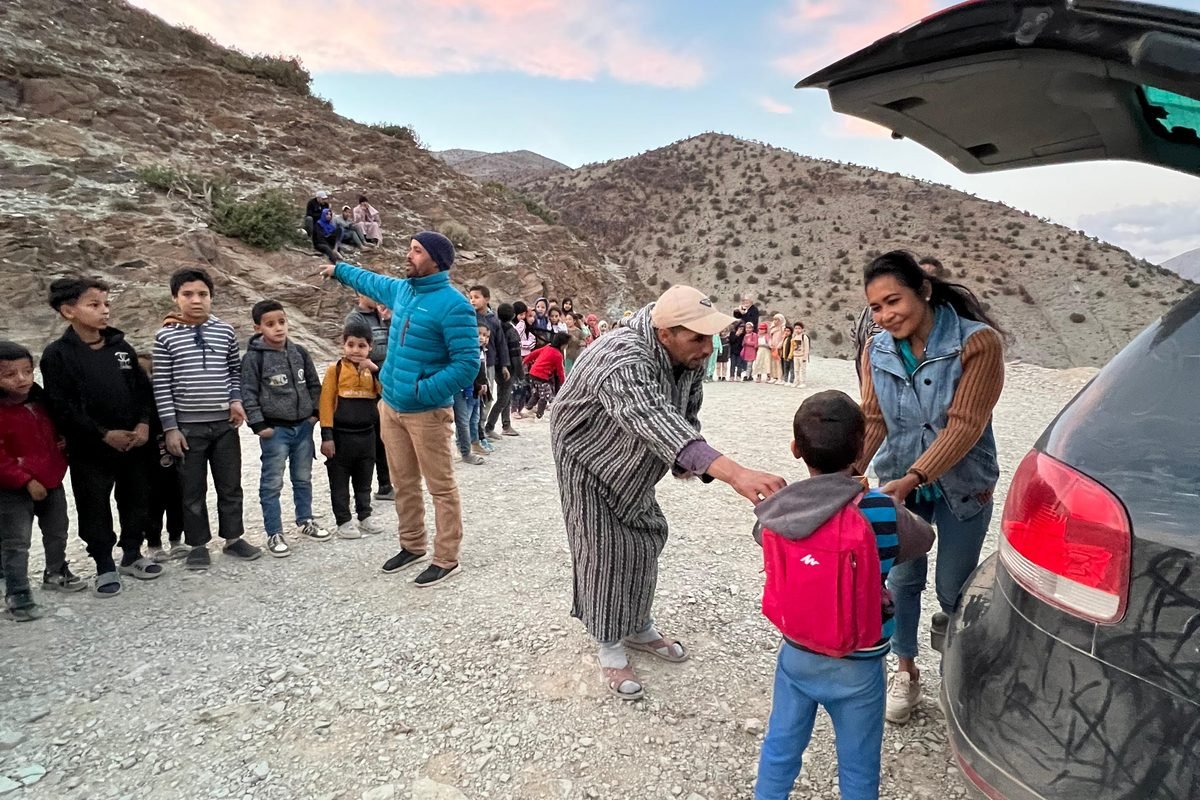
With the local partner, find schools that have a structure but cannot function.
A clear, costed list of exactly what each school needs to reopen.
Buy equipment and source refurbished IT and solar in kind to stretch every euro.
Reach the difficult, mountainous and remote areas — and install on site.
Deliver with, not merely to, the receiving school and community.
A documented "where your money went" report — photos, delivery records, a simple budget.
The 6.8-magnitude Al Haouz earthquake of 8 September 2023 killed 2,946 people, damaged some 530 educational institutions (343 in Al Haouz province alone, 103 completely destroyed) and affected roughly one million pupils.
Morocco's response is serious money — a five-year MAD 120 billion programme and €1 billion from the European Investment Bank (second €500m tranche released June 2026). But that money builds the shells; it does not furnish or equip them. As of September 2025, around 220 schools across Al Haouz, Azilal and Chichaoua were still not functioning. That gap — desks, IT and power for rebuilt schools — is exactly our product.
Stage 2 — going back: scenario-based and scaled strictly to funds raised — a downside at €60,000 (six schools), a base at €100,000 (ten schools) and a stretch at €150,000 (fifteen schools, including three full solar-and-IT hubs). We mobilise in November 2026 and deliver through 2027, working through a registered Moroccan partner association — the established, lawful route, where our relationships from two prior missions give us a head start.
The Philippines is among the most disaster-exposed countries on earth, and its schools bear the brunt. In November 2025, Typhoon Tino damaged over 2,900 classrooms across Western Visayas — 2,156 with minor damage, 806 major and 391 destroyed — on top of a national backlog of around 165,000 classrooms.
Our programme on Panay Island runs on two strands: Strand A, a three-year education and skills programme built around the TESDA-accredited Mina Skills Training Centre (€500,000); and Strand B, our core trade — desks, learning materials, refurbished computers and solar power for typhoon-hit Iloilo schools through the DepEd Adopt-a-School framework (€100,000, ten schools).
Firewall: School Aid's Panay education work sits alongside — and strictly firewalled from — the founder's for-profit venture (Biomass Asia Inc). Charitable funds never touch the commercial plant; money flows one way only, from the for-profit to the charity; and the charity's Board decides. We teach; we never make or sell any commercial product.
On 24 June 2026, twin earthquakes of magnitude 7.2 and 7.5 struck Venezuela's north-central coast, killing at least ~2,295 people and destroying more than 400 schools — 432 in the Capital District alone — in the country's most populated corridor. Venezuela was already the hemisphere's education emergency, with roughly 3 million children out of school. This is exactly our Replace tier.
We deliver in two funding-gated phases: Pods first — tented, fully equipped learning spaces with solar light and power, operational within days (€8,500 each) — then Cubes: 40-foot containers fitted out locally into solar-powered, satellite-connected modular classrooms, seismically engineered and joinable into multi-classroom campuses.
Compliance-first: Venezuela is our most demanding compliance environment. Nothing proceeds without an Estonian counsel sanctions opinion and Board sign-off, re-verified before every transfer. We act as offshore funder and technical partner to a registered local partner, maintain strict political neutrality, and monitor end-use rigorously.
Each package is tailored per school with the local partner. We stretch cash by sourcing equipment in kind wherever possible.
Desks, chairs, boards, books and the teaching materials a classroom needs to run.
Sourced in kind from partners such as Close the Gap, Labdoo and World Computer Exchange.
Panels and storage so power, light and learning continue — day or night, on or off the grid.
Indicative all-in cost is on the order of €8,000–€12,000 per school — a planning estimate, refined against each mission's actuals.
Your gift becomes desks, computers and power in a school that a disaster left behind.